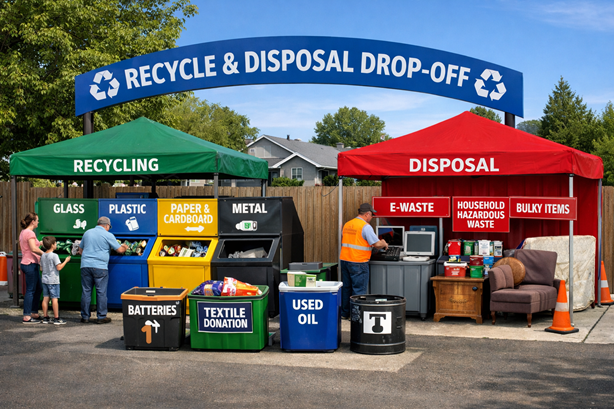
Landfill diversion keeps more material circulating in the economy and out of the ground, so you cut emissions, save disposal costs, and extend landfill life all at once. By prioritizing recycling, composting, and targeted reuse, you can reduce the volume sent to landfills and capture real environmental and economic benefits.
This article Landfill Diversions shows practical waste management strategies you can apply and explains how those choices affect both the environment and your bottom line. Expect clear steps you can use and measurable outcomes to track as you shift waste from disposal toward recovery.
Waste Management Strategies
You will focus on practical actions that reduce what reaches landfills: sorting at the source, processing materials through recycling and composting, and finding ways to reuse or upcycle items. Each approach requires specific infrastructure, clear policies, and consistent public participation.
Source Separation Techniques
You should set up collection streams that make correct sorting easy and routine. Use separate bins for organics, recyclables (fiber, containers), and residuals; label them with clear icons, color codes, and local language instructions. Provide curbside pickup schedules and place-sorting rules on your municipality’s website and on-street signage to reduce contamination rates.
Implement mandatory or incentivized separation policies where feasible. Offer free kitchen caddies for food scraps, phased rollouts of organics collection, and contamination penalties or pay-as-you-throw pricing to encourage compliance. Train collection crews and run regular audits so you can measure capture rates and adjust outreach.
Recycling and Composting Systems
You must invest in facility capacity matched to the materials you collect. For recycling, ensure material recovery facilities (MRFs) accept the specific stream mix you provide; prioritize single-stream only if contamination controls and sorting upgrades exist. For composting, choose between in-vessel, windrow, or aerated static pile systems based on feedstock volume, land availability, and odor controls.
Standardize acceptable materials lists, publish contamination thresholds, and report diversion metrics publicly. Build markets by procuring recycled-content products and partnering with local businesses. Combine technical upgrades (optical sorters, trommels) with education campaigns to increase yield and lower processing costs.
Reuse and Upcycling Innovations
You should create programs that keep durable goods in circulation before disposal. Establish repair cafés, drop-off hubs for reusable building materials, and municipal reuse stores that sell or redistribute furniture, appliances, and textiles. Integrate take-back requirements for electronics and textiles with certified refurbishers to reduce hazardous waste and recover valuable components.
Promote circular procurement policies within your institutions to prefer remanufactured or reused items. Support digital platforms that match donors with recipients and track item flows. Measure success by tracking items diverted, revenue from resale, and reductions in acquisition of new products.
Environmental And Economic Impacts
Landfill diversion reduces methane emissions, lowers disposal costs, and preserves materials for reuse and recycling. These effects influence municipal budgets, local air and water quality, and the supply of secondary raw materials.
Reduction of Greenhouse Gas Emissions
You cut methane generation by keeping organic and divertible materials out of anaerobic landfill zones. Composting and anaerobic digestion stabilize organics so they emit far less methane over time than the same material in a landfill.
Landfill gas capture systems can reduce emissions, but they rarely reach 100% efficiency; diversion reduces the volume that needs capture. Targeting food scraps, yard waste, textiles, and paper yields the largest immediate reductions in methane per ton diverted.
Measuring benefits requires local data: waste composition, diversion rates, capture efficiency, and transport emissions. Use site-specific assumptions when estimating CO2e reductions to avoid over- or underestimating climate benefits.
Cost Savings for Municipalities
You lower long-term disposal costs by reducing tonnage sent to landfill and slowing the need for new landfill capacity. That can delay capital expenditures for new cells, extend the life of existing sites, and reduce landfill tipping fee revenue dependence.
Operational savings appear in avoided hauling and reduced landfill operating and closure liabilities. However, diversion programs can require upfront investment in collection infrastructure, processing facilities, and public education. Compare program costs to avoided disposal and post-closure costs to assess net savings.
Consider revenue streams from recovered materials and renewable energy (e.g., biogas). These incomes can offset program costs but fluctuate with market prices and contract terms. Conduct a multi-year financial model to capture variability.
Resource Conservation
You conserve primary raw materials by recovering paper, metal, glass, plastics, and organics for reuse and recycling. This reduces demand for virgin extraction and the associated energy, water, and land impacts.
Recycling often delivers clear energy and emissions benefits for metals and paper when collection and processing are efficient. Composting returns nutrients and organic matter to soils, improving soil structure and reducing fertilizer needs.
Prioritize high-value streams for collection and ensure quality controls to avoid contamination that undermines recycling markets. Track material recovery rates, markets, and end‑use quality to maximize environmental and economic value.